
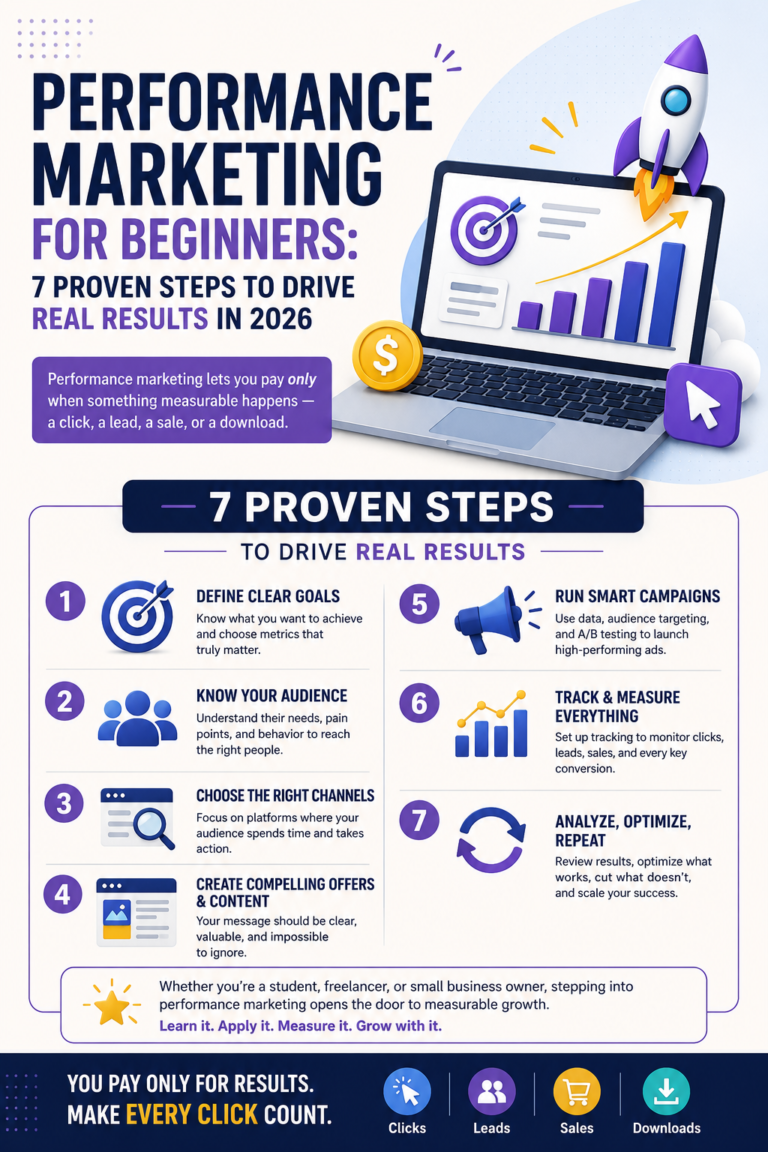
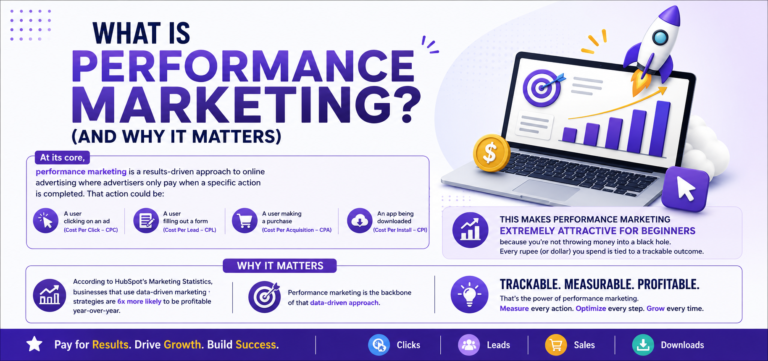
Step 1: Understand the Core Channels
Before running any campaign, you need to know where performance marketing happens. The main channels include:
1. Search Engine Marketing (SEM/PPC) Platforms like Google Ads let you bid on keywords so your ad appears when someone searches for a relevant term. You only pay when someone clicks — that’s the “pay-per-click” or PPC model.
2. Social Media Advertising Meta Ads (Facebook & Instagram), LinkedIn Ads, and Snapchat Ads allow you to target users based on demographics, interests, and behaviours. These are powerful platforms for performance marketing because of the granular targeting options available.
3. Affiliate Marketing You partner with publishers or influencers who promote your product. They earn a commission only when they drive a sale or lead — making this a pure performance-based model.
4. Display & Programmatic Advertising Banner ads placed across websites using ad networks. You can set performance goals like cost-per-click or cost-per-view.
5. Email Marketing (Performance-Based) Tracking email open rates, clicks, and conversions to measure and optimize campaign performance over time.
Step 2: Define Your Goals and KPIs
This is where most beginners go wrong — they run ads without clearly defined goals. Before spending even ₹1 on any campaign, ask yourself:
- What action do I want the user to take?
- How much am I willing to pay for that action?
- What does success look like in numbers?
Common KPIs (Key Performance Indicators) in performance marketing:
| KPI | What It Measures |
|---|---|
| CTR (Click-Through Rate) | % of people who clicked your ad |
| CPC (Cost Per Click) | How much you pay per click |
| CPL (Cost Per Lead) | Cost of acquiring one lead |
| CPA (Cost Per Acquisition) | Cost of acquiring one customer |
| ROAS (Return on Ad Spend) | Revenue earned per ₹ spent on ads |
| Conversion Rate | % of visitors who complete the desired action |
Pro Tip: Start with one goal — don’t try to track everything at once when you’re just starting out.
Step 3: Set a Realistic Budget
One of the biggest misconceptions about performance marketing for beginners is that you need a massive budget. You don’t.
Here’s a beginner-friendly budget breakdown to start:
- Google Ads: Start with ₹300–₹500/day to test keywords
- Meta Ads: ₹200–₹400/day for awareness or lead generation campaigns
- Affiliate Marketing: No upfront cost — you pay commissions on results
Start small, test, and scale what works. Most platforms require a minimum daily budget of ₹100–₹200 to generate meaningful data.
Step 4: Know Your Target Audience
Performance marketing without audience research is like shouting into a crowd and hoping the right person hears you. Before launching any campaign:
- Create a buyer persona — who is your ideal customer? (age, location, income, interests, pain points)
- Use tools like Google Analytics, Meta Audience Insights, and SEMrush to research your audience
- Understand where your audience spends time online
For example, if you’re marketing a fashion brand to women aged 18–28 in Delhi, Instagram and Meta Ads with interest-based targeting will perform far better than LinkedIn.
Step 5: Create High-Converting Ad Creative
Your ad creative — the copy, image, or video — is what makes or breaks a performance campaign. Even the best targeting won’t save a bad ad.
For performance marketing, your creative must:
Have a clear, benefit-driven headline  Include a strong Call-To-Action (CTA) — “Shop Now,” “Get a Free Quote,” “Download Today” Speak directly to the user’s pain point or desire Be visually clean and mobile-optimized (80%+ of users see ads on mobile) Be tested in multiple variations (A/B Testing)
A/B Testing (also called Split Testing) means running two versions of your ad — same everything except one variable — to see which performs better. This is a non-negotiable practice in professional performance marketing.
Step 6: Track, Measure, and Optimize
This is where performance marketing truly shines over traditional advertising. Every click, every impression, every conversion is trackable.
Tools every beginner should know:
- Google Analytics 4 (GA4): Tracks website traffic, user behaviour, and conversions
- Meta Ads Manager: Tracks ad performance across Facebook and Instagram
- Google Ads Dashboard: Monitors search campaign performance
- Hotjar: Heatmaps to understand user behaviour on landing pages
- UTM Parameters: Tags added to your URLs to track which campaign drove each visit
After running your campaign for 5–7 days, review:
- Which ad has the highest CTR?
- Which audience segment converts the best?
- Which channel gives you the lowest CPA?