
Performance Marketing for Beginners: 7 Proven Steps to Drive Real Results in 2026
Performance marketing for beginners can feel overwhelming at first — but once you understand how it works, it becomes one of the most powerful and budget-friendly ways to grow a business online. Unlike traditional advertising, where you pay upfront and hope for results, performance marketing lets you pay only when something measurable happens — a click, a lead, a sale, or a download.
Whether you’re a student, freelancer, or small business owner just stepping into the world of digital marketing, this complete guide will walk you through everything you need to know — from what performance marketing actually means to which channels to use and how to measure success.\
What Is Performance Marketing? (And Why It Matters)
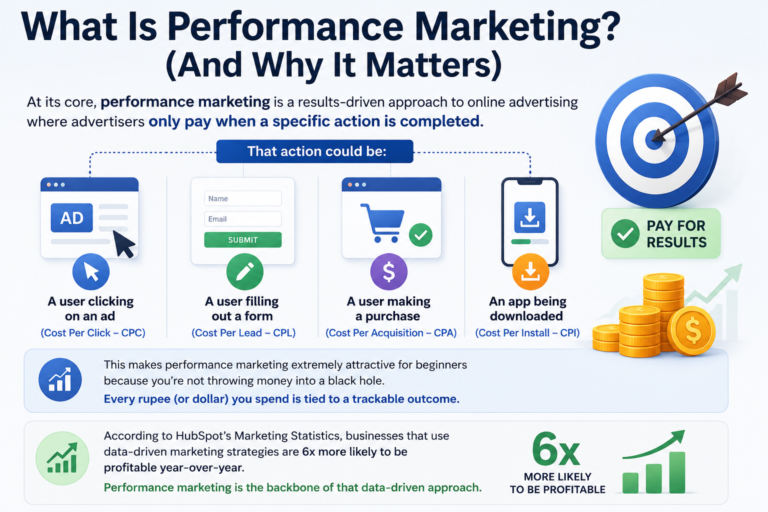
At its core, performance marketing is a results-driven approach to online advertising where advertisers only pay when a specific action is completed. That action could be:
- A user clicking on an ad (Cost Per Click – CPC)
- A user filling out a form (Cost Per Lead – CPL)
- A user making a purchase (Cost Per Acquisition – CPA)
- An app being downloaded (Cost Per Install – CPI)
This makes performance marketing extremely attractive for beginners because you’re not throwing money into a black hole. Every rupee (or dollar) you spend is tied to a trackable outcome.
According to HubSpot’s Marketing Statistics, businesses that use data-driven marketing strategies are 6x more likely to be profitable year-over-year. Performance marketing is the backbone of that data-driven approach.
Performance Marketing for Beginners: 7 Proven Steps to Get Started
Step 1: Understand the Core Channels
Before running any campaign, you need to know where performance marketing happens. The main channels include:
1. Search Engine Marketing (SEM/PPC) Platforms like Google Ads let you bid on keywords so your ad appears when someone searches for a relevant term. You only pay when someone clicks — that’s the “pay-per-click” or PPC model.
2. Social Media Advertising Meta Ads (Facebook & Instagram), LinkedIn Ads, and Snapchat Ads allow you to target users based on demographics, interests, and behaviours. These are powerful platforms for performance marketing because of the granular targeting options available.
3. Affiliate Marketing You partner with publishers or influencers who promote your product. They earn a commission only when they drive a sale or lead — making this a pure performance-based model.
4. Display & Programmatic Advertising Banner ads placed across websites using ad networks. You can set performance goals like cost-per-click or cost-per-view.
5. Email Marketing (Performance-Based) Tracking email open rates, clicks, and conversions to measure and optimize campaign performance over time.
Step 2: Define Your Goals and KPIs
This is where most beginners go wrong — they run ads without clearly defined goals. Before spending even ₹1 on any campaign, ask yourself:
- What action do I want the user to take?
- How much am I willing to pay for that action?
- What does success look like in numbers?
Common KPIs (Key Performance Indicators) in performance marketing:
| KPI | What It Measures |
|---|---|
| CTR (Click-Through Rate) | % of people who clicked your ad |
| CPC (Cost Per Click) | How much you pay per click |
| CPL (Cost Per Lead) | Cost of acquiring one lead |
| CPA (Cost Per Acquisition) | Cost of acquiring one customer |
| ROAS (Return on Ad Spend) | Revenue earned per ₹ spent on ads |
| Conversion Rate | % of visitors who complete the desired action |
Step 3: Set a Realistic Budget
One of the biggest misconceptions about performance marketing for beginners is that you need a massive budget. You don’t.
Here’s a beginner-friendly budget breakdown to start:
- Google Ads: Start with ₹300–₹500/day to test keywords
- Meta Ads: ₹200–₹400/day for awareness or lead generation campaigns
- Affiliate Marketing: No upfront cost — you pay commissions on results
Start small, test, and scale what works. Most platforms require a minimum daily budget of ₹100–₹200 to generate meaningful data.
Step 4: Know Your Target Audience
Performance marketing without audience research is like shouting into a crowd and hoping the right person hears you. Before launching any campaign:
- Create a buyer persona — who is your ideal customer? (age, location, income, interests, pain points)
- Use tools like Google Analytics, Meta Audience Insights, and SEMrush to research your audience
- Understand where your audience spends time online
For example, if you’re marketing a fashion brand to women aged 18–28 in Delhi, Instagram and Meta Ads with interest-based targeting will perform far better than LinkedIn.
Step 5: Create High-Converting Ad Creative
Your ad creative — the copy, image, or video — is what makes or breaks a performance campaign. Even the best targeting won’t save a bad ad.
For performance marketing, your creative must:
✅ Have a clear, benefit-driven headline ✅ Include a strong Call-To-Action (CTA) — “Shop Now,” “Get a Free Quote,” “Download Today” ✅ Speak directly to the user’s pain point or desire ✅ Be visually clean and mobile-optimized (80%+ of users see ads on mobile) ✅ Be tested in multiple variations (A/B Testing)
A/B Testing (also called Split Testing) means running two versions of your ad — same everything except one variable — to see which performs better. This is a non-negotiable practice in professional performance marketing.
Step 6: Track, Measure, and Optimize
This is where performance marketing truly shines over traditional advertising. Every click, every impression, every conversion is trackable.
Tools every beginner should know:
- Google Analytics 4 (GA4): Tracks website traffic, user behaviour, and conversions
- Meta Ads Manager: Tracks ad performance across Facebook and Instagram
- Google Ads Dashboard: Monitors search campaign performance
- Hotjar: Heatmaps to understand user behaviour on landing pages
- UTM Parameters: Tags added to your URLs to track which campaign drove each visit
After running your campaign for 5–7 days, review:
- Which ad has the highest CTR?
- Which audience segment converts the best?
- Which channel gives you the lowest CPA?
Then, pause what isn’t working. Increase budget on what is. Repeat.
Step 7: Scale What Works
Once you’ve found a winning combination of audience + creative + channel, it’s time to scale. Scaling in performance marketing means:
- Gradually increasing your daily budget (by 15–20% every few days — not all at once)
- Expanding your audience (lookalike audiences, new geographies)
- Testing new ad formats (video vs. image, carousel vs. single ad)
- Retargeting users who clicked but didn’t convert
Retargeting is one of the most powerful tools available — people who’ve already shown interest in your product are 70% more likely to convert when shown a follow-up ad.
Common Mistakes Beginners Must Avoid in Performance Marketing
with the best intentions, beginners often make these costly errors:
❌ Setting and forgetting — campaigns need daily or weekly monitoring ❌ Ignoring the landing page — a great ad with a bad landing page will waste your entire budget ❌ Targeting too broadly — narrow, focused audiences convert better ❌ Not testing creatives — always run A/B tests ❌ Chasing vanity metrics — impressions don’t pay bills; conversions do
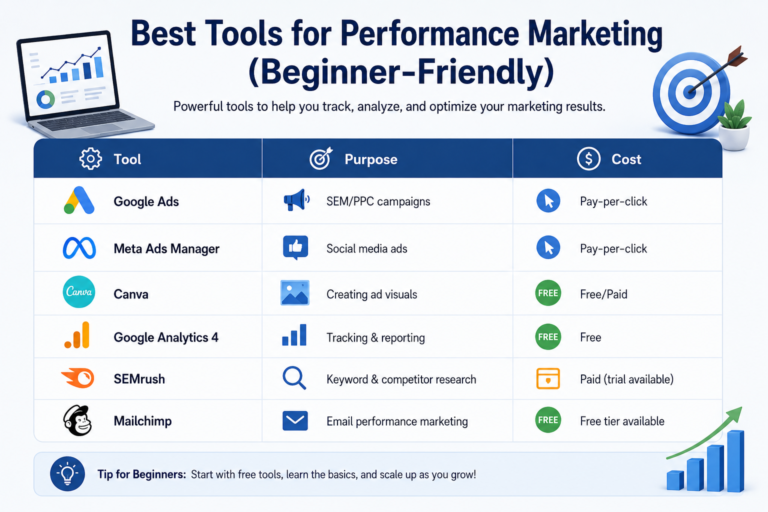
Best Tools for Performance Marketing (Beginner-Friendly)
| Tool | Purpose | Cost |
|---|---|---|
| Google Ads | SEM/PPC campaigns | Pay-per-click |
| Meta Ads Manager | Social media ads | Pay-per-click |
| Canva | Creating ad visuals | Free/Paid |
| Google Analytics 4 | Tracking & reporting | Free |
| SEMrush | Keyword & competitor research | Paid (trial available) |
| Mailchimp | Email performance marketing | Free tier available |
Is Performance Marketing Right for You?
Performance marketing for beginners is ideal if you:
- Have a product or service to sell online
- Want measurable ROI from every campaign
- Have a small-to-medium budget and can’t afford to waste it
- Are willing to learn, test, and optimize continuously
It’s not a magic wand — but it is one of the most transparent, scalable, and beginner-accessible forms of digital advertising available today.
Final Thoughts
Performance marketing for beginners doesn’t have to be complicated. Start with one channel, define one goal, and track one KPI. As your confidence and data grow, expand your strategy. The biggest advantage you have as a beginner is that every mistake is a lesson — and every lesson makes your next campaign more profitable.
The digital marketing world rewards those who test, learn, and adapt. So don’t wait for the “perfect” campaign — launch, learn, and optimize your way to results.